
Dinant and the Meuse Valley, Wallonia
Dinant and the Meuse Valley: the day trip from Brussels most visitors miss
A Belgian's guide to a day around Dinant: a castle above the Lesse, a cave sixty metres down, Trappist beer where it is brewed, and gardens made to be seen from above.
Most visitors see Belgium as three cities: Bruges, Ghent and Brussels. They are worth it. But drive an hour and twenty minutes south of Brussels and the country changes completely. The land folds into cliffs and forests. Two rivers, the Meuse and the Lesse, cut through it. Castles sit on the rocks above the water, and some of them are still family homes.
This is the part of Belgium I know best. I first saw most of these places as a child with my family, or found them by accident while camping with friends. You will not meet many other tourists here. This is how I would spend one day in the valley around Dinant, in the order that works.
Start above the Lesse, at Walzin
Château de Walzin stands on top of a cliff above the Lesse, upstream from where it flows into the Meuse. It is private property and a family home, so you cannot go in. That is exactly what makes it worth seeing. It is not a museum or a foundation. It is a castle where people never left.
You see it best from across the water. Below the cliff, kayakers float past all day on their way down to Anseremme, where the Lesse meets the Meuse. That is how I found this view myself: kayaking and wild camping with friends. The spot is known locally, but nobody pushes it, so you often have it almost to yourself.
On our days, this is where the coffee comes out. Coffee, tea, Belgian cookies and good chocolate, poured slowly while the castle story gets told. It is a simple stop, and it is the one guests mention most often afterwards.
Sixty metres down at Rochefort
From Walzin it is about forty minutes to Rochefort and the Grotte de Lorette. The river Lomme carved these chambers out of the rock. The guided visit takes you down to about sixty metres, where it is around eight degrees all year. Bring a layer. On a hot summer day, it is the best hour of the day.
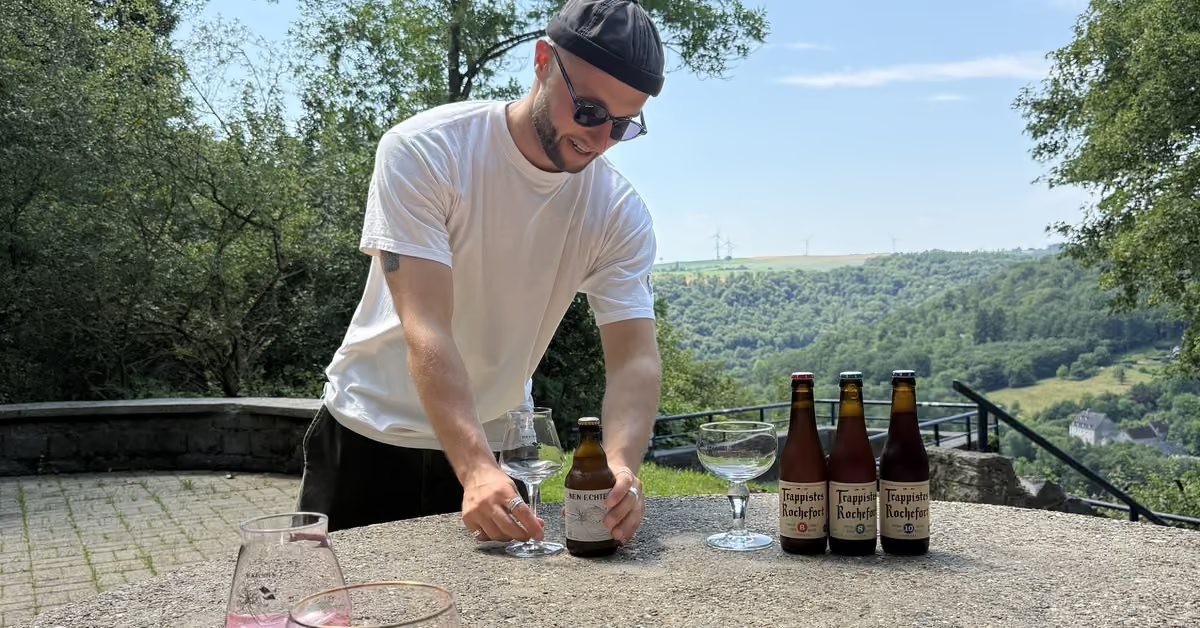
Rochefort is also a name every beer lover knows. The Abbey of Saint-Rémy has been brewing here since 1595, and it is closed to visitors, always. So the only way to meet Rochefort is at a table. Drinking it in Rochefort itself, a few kilometres from an abbey nobody may enter, is about as close as you can get.
A short guide to what is in the glass. A Trappist beer is brewed inside the walls of a Trappist abbey, under the monks’ control, and the profit goes to the abbey and to charity. Belgium has five: Chimay, Orval, Rochefort, Westmalle and Westvleteren. Abbey beers like Leffe or Grimbergen are something else. They are brands that license an abbey’s name, not beers made by monks. And no, the monks have not taken a vow of silence.
The way I explain it to guests: the monks do not live to brew beer. They brew beer so they can afford to be monks.
Rochefort makes three beers: the 6, the 8 and the 10, at 7.5, 9.2 and 11.3 percent. If you only try one, make it the 8. Pour lighter before darker, lower before stronger, and give every Trappist its own glass. In Belgium, serving a beer in the wrong glass is somewhere between a mistake and a scandal.
Vêves, the castle you can walk into
Château de Vêves is the castle people imagine when they think of Europe and almost never actually see: pointed towers, thick stone walls and a real drawbridge. It is also one of the few castles in the area you can walk all the way into.
According to the château’s own history, it has been held by the Sires de Beaufort and their descendants, the Counts of Liedekerke Beaufort, since the twelfth century. Guests often say it looks bigger from the outside than it feels inside. That is because of the courtyard in the middle. I tell them before they notice. Of all the interiors in the valley, this is the one I rate highest.
Two things to know. Outside the summer and school holidays, Vêves opens mostly on weekends and public holidays, so check the date before you build a day around it. And the château is not wheelchair accessible.
Celles, where the Battle of the Bulge stopped
Celles is a short drive from Vêves, and it is one of the Most Beautiful Villages of Wallonia. It is also a place with real weight.
In December 1944, the German army launched a surprise offensive through the Ardennes and pushed a bulge into the Allied lines. The Battle of the Bulge lasted from 16 December 1944 to 25 January 1945. Celles is where the German advance got furthest. A German tank still stands at the edge of the village to mark the spot. It was the largest and bloodiest battle the United States fought in the Second World War, with about 89,000 American casualties, 19,000 of them killed.
If anyone in your group cares about military history, this is their stop. Get out of the car, read the plaque, and walk into the village afterwards.
Freÿr, gardens made to be seen from above
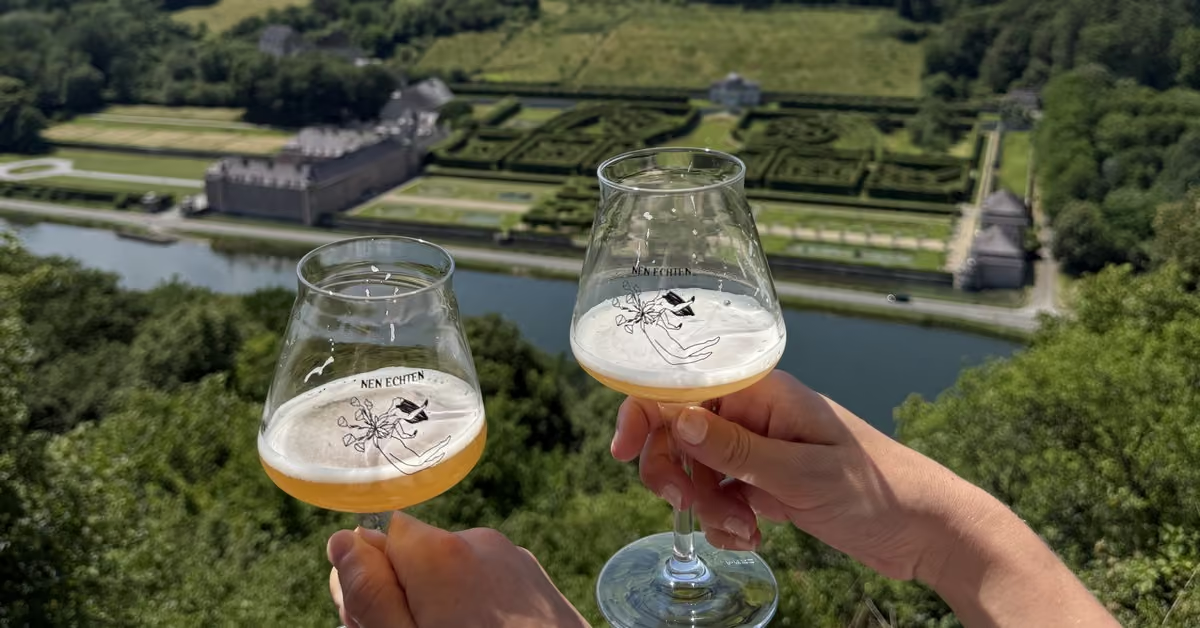
Château de Freÿr sits on the Meuse at Hastière, about six minutes by car from the centre of Dinant. Before you go through the gate, take the footpath up to the viewpoint on the cliff. From there the whole estate lies open: the white Renaissance château, the formal French gardens laid out in clean lines, and the river running along the edge.
The design only makes full sense from above, and that is the point. These gardens were made to be looked down on. It is the photograph almost everyone takes home.
Then walk down into it. On the ground the scale changes: long paths, clipped hedges, lines that lead your eye to the water. Look for the orange trees, some of them around three centuries old. Like Walzin, Freÿr is still a family home, and you can feel it. After a morning of caves and castles, this is where the day slows down.
A useful detail: the viewpoint is outside the estate. On days when Freÿr is closed, the view from the cliff is still there.
Dinant itself
Dinant is the town that ties the valley together, squeezed between the Meuse and a wall of rock. Above it all stands the citadel. Below the cliff is the collegiate church of Notre-Dame, with its pear-shaped bell tower. In 1227 part of the cliff collapsed onto the original church, and it was rebuilt.
The bridge across the Meuse is lined with giant saxophones, and there is a good reason. Adolphe Sax was born in Dinant in 1814. He patented the saxophone in 1846, spent years fighting rival instrument makers in court, and died in 1894 with very little. Jazz made him immortal later. His house in town is open to walk into, and there is a bench next to his bronze statue.
Dinant has darker history too. On 15 August 1914, a 23-year-old French lieutenant named Charles de Gaulle was wounded here. Eight days later, on 23 August 1914, German troops executed 674 civilians in the town. That was the First World War, not the Second, and Dinant still remembers it.
Before you leave, buy a couque de Dinant: honey and flour pressed into a carved wooden mould and baked rock hard. Do not bite it. Break off a piece and let it melt.
In Belgium, a road without houses on it counts as remote. The roads between these stops are some of the few that qualify. That is the real reason to come here: not one famous sight, but a whole valley that most visitors to Belgium never find.
Rather not plan it yourself?
This is one of the private days we run from Brussels or Ghent. Pickup at your hotel, lunch and drinks throughout, one party per day. Tell us your dates and we build the day around you.
Plan your day